
AI Is Easy. Organisational Readiness Is Hard.
Published: November 22nd 2026
4 minute read - Reflections from True Blue Blazing Melbourne 2026
Access to AI has become easy. Scaling it responsibly remains the challenge.
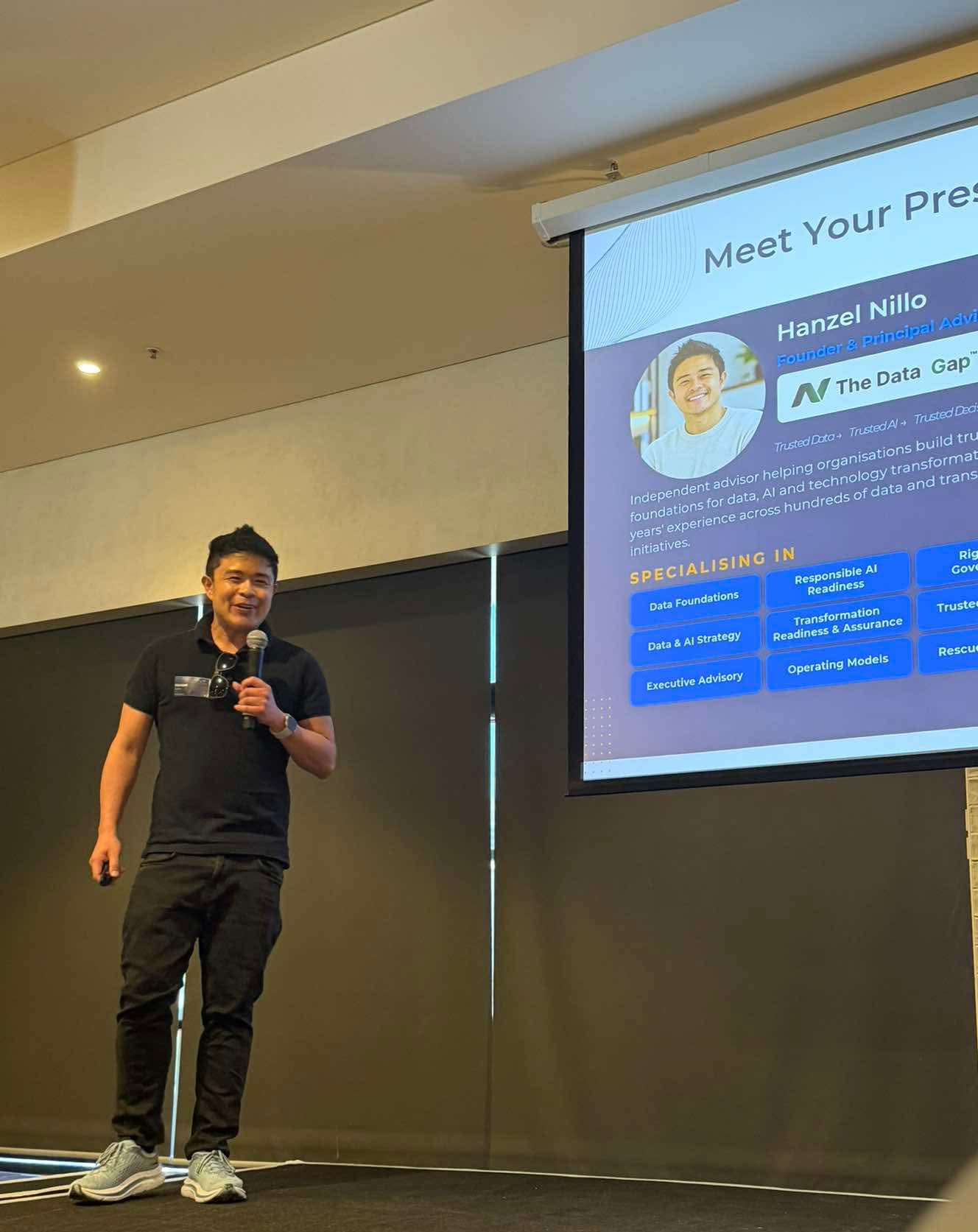
Last month I presented alongside Jason Lawrence from AgentFix at True Blue Blazing Melbourne 2026. Our session title was deliberately provocative: AI Is Easy. Organisational Readiness Is Hard.
We didn't mean AI itself is easy. We meant that access to it has become far easier than most organisations expected. Microsoft Copilot, ChatGPT, Claude, Gemini, Perplexity, Slackbot, Agentforce and a growing list of AI-enabled platforms are available to almost any organisation that wants them, and the technology keeps improving at an extraordinary pace.
After more than 20 years working across data and technology transformation programs, I'm seeing this pattern emerge more consistently than ever before. The technology is rarely the biggest challenge. Readiness is.
Why the title is provocative
We chose the title to challenge a common assumption: that adopting AI is mainly a technology decision. Tools can be switched on in minutes. Trusted data, clear ownership, capable people, sensible guardrails and measurable outcomes take far longer to build.
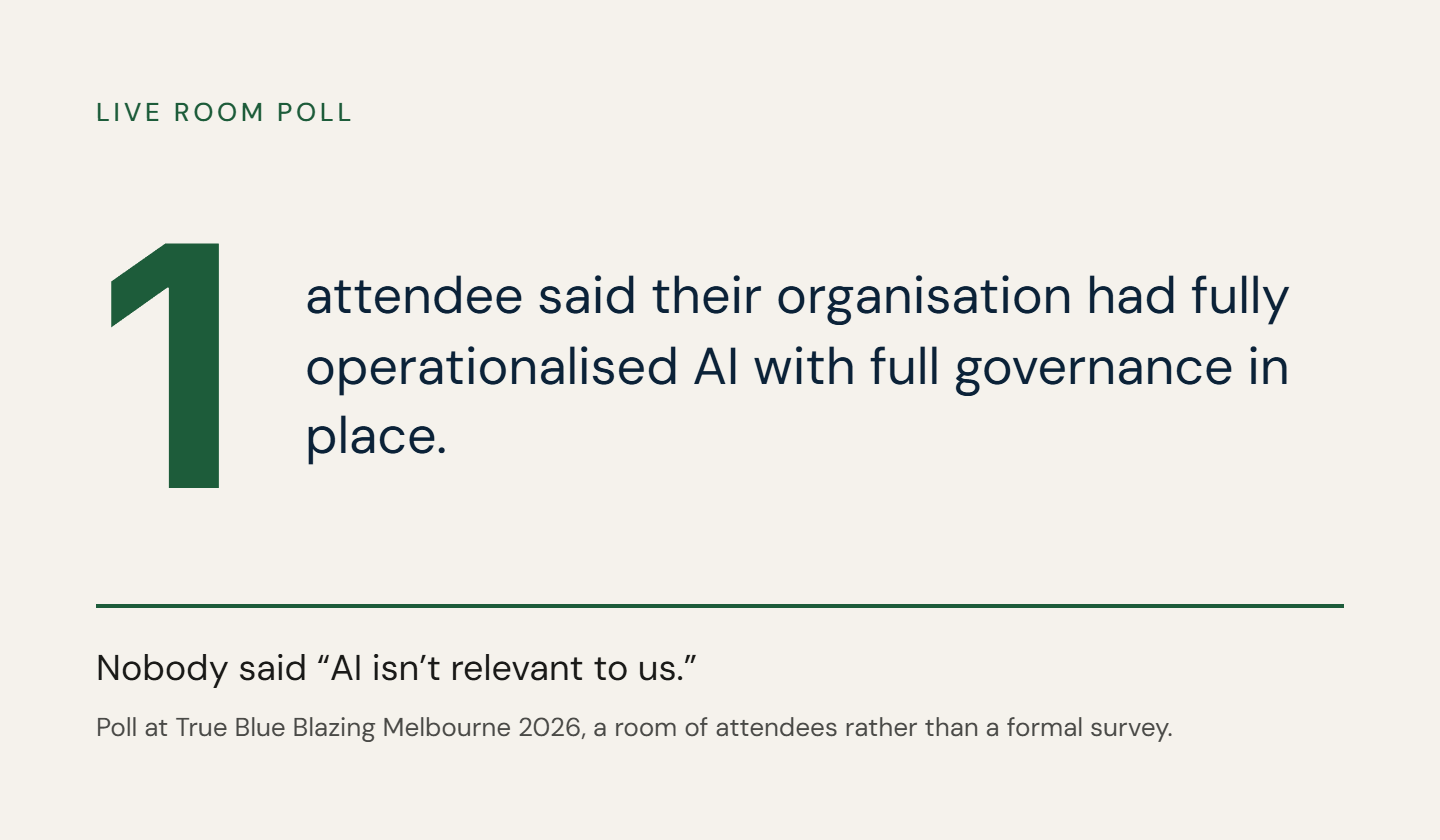
To test this in the room, we ran a live poll of attendees at True Blue Blazing. The results were telling:
Only 1 attendee said their organisation had fully operationalised AI with full governance in place.
Nobody said "AI isn't relevant to us."
This was a room of attendees rather than a formal survey, but the pattern matched what we see in practice. Almost everyone is engaging with AI. Very few have the foundations to do it responsibly at scale.
True Blue Blazing Live Poll Result:
AI exposes and amplifies what already exists
AI doesn't fix weak foundations. It exposes them, then amplifies them. Inconsistent data becomes inconsistent answers at speed. Unclear ownership becomes unclear accountability for automated decisions. Unmanaged processes become unmanaged risk.
That's why so many pilots stall between proof of concept and production. The model works. The organisation around it isn't ready.
Trusted data comes first
Trusted AI starts with trusted data. Before scaling any AI use case, organisations need confidence in where their data lives, how accurate it is, who owns it and who can access it.
That also means keeping a human in the loop. AI can draft, summarise and recommend, but people remain accountable for the decisions. Defining where human judgement is required, and how it is exercised, is a design choice, not an afterthought.
Finally, guardrails matter. Just because you can doesn't mean you should: decide what sensitive data AI can access, under what conditions, and with what oversight, before a tool makes that decision for you.
What I see in practice
Recently, we worked with an organisation that was eager to expand the use of AI by connecting it to internal file repositories, collaboration platforms and core business systems. The technology itself was not the challenge. The organisation first needed to understand what information AI could access, who was responsible for governing that information and whether appropriate controls existed for sensitive or confidential content. Before scaling AI, the focus shifted to governance, risk assessment and establishing practical guardrails that could support responsible use.
In another engagement, an organisation wanted to accelerate AI adoption to improve reporting, decision-making and operational efficiency. However, early discussions revealed underlying issues with data quality, ownership and inconsistent processes across teams. Rather than starting with AI implementation, the organisation invested time in clarifying responsibilities, improving data confidence and strengthening governance foundations. As a result, they were better positioned to evaluate AI opportunities with greater confidence and lower risk.
The pattern is consistent. Organisations that treat AI as a technology purchase struggle. Organisations that treat it as a transformation of data, governance, people and process make progress, and they move faster once the foundations are in place.

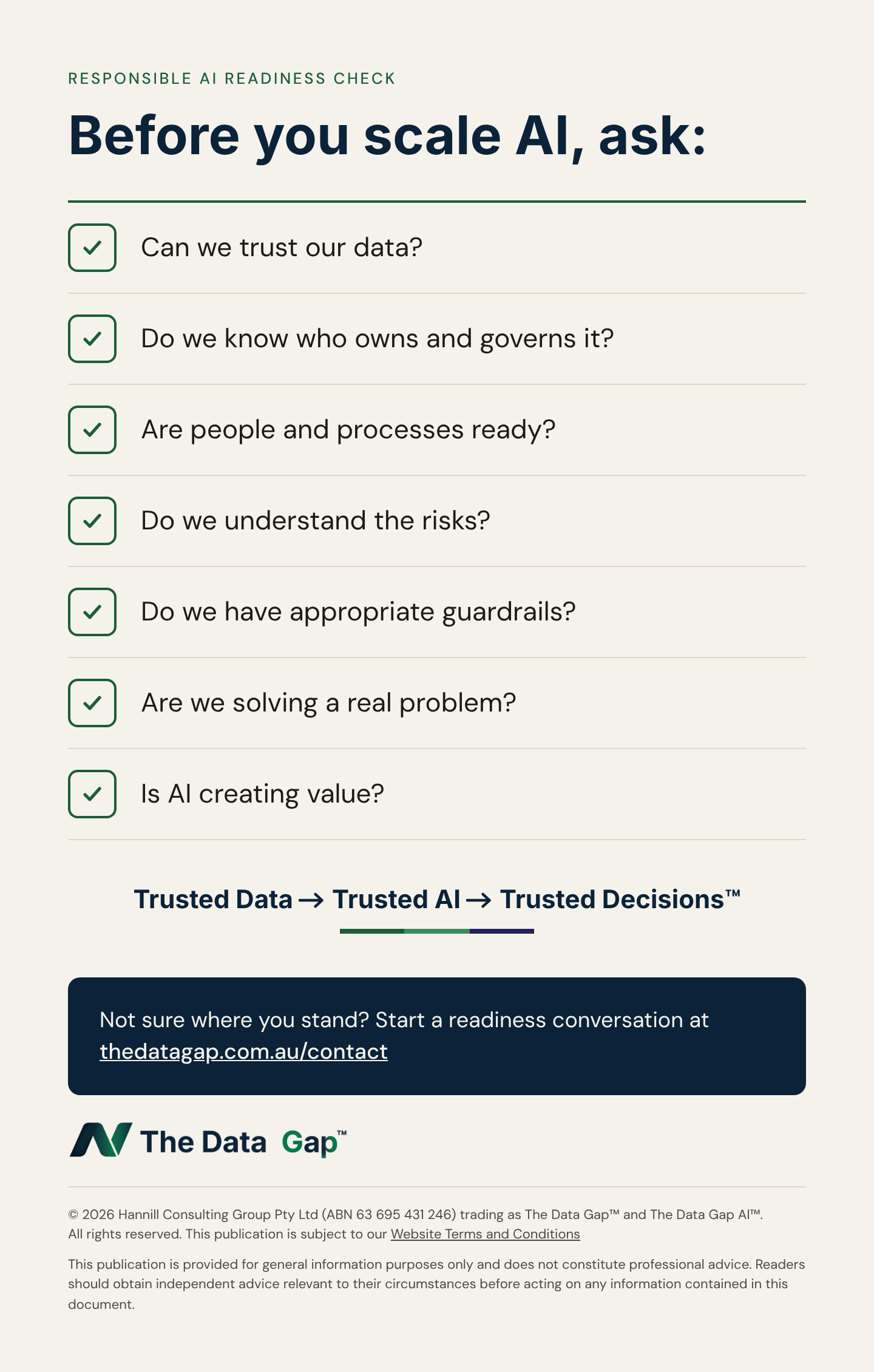
Seven questions to ask before you scale AI - Our Responsible AI Readiness Checklist
Here is our Responsible AI Readiness checklist we shared in the session. Answer Yes or Not yet to each
Count your "Not yet" answers. Zero to one: strong footing. Two to three: pockets of readiness. Four or more: start with the foundations.
The AI Readiness Gap
The AI readiness gap is becoming one of the defining strategic challenges organisations will face over the next decade. While AI capabilities continue to accelerate, trust, governance and organisational readiness will increasingly determine who captures value and who struggles to scale.
Session materials and thanks
Thank you to the True Blue Blazing organisers and attendees for the conversation, and to Jason Lawrence of AgentFix for co-presenting.
You can download the full presentation along with our Responsible AI Readiness Checklist in our Knowledge Hub Page.
About The Author

Hanzel Nillo - The Data Gap™
Founder & Principal Advisor
Over 20 years helping organisations navigate data, technology transformation and in recent years the application of responsible AI solutions.


The organisations that win
The organisations that get the most from AI won't be the ones that adopted it first. They'll be the ones that built trusted foundations first, and can show the value.
If you're not sure where you stand, start a readiness conversation with us
Follow Our Professional Updates
